How to Make Compost Tea at Home for Kitchen Garden Pots
How to Make Compost Tea at Home for Kitchen Garden Pots

Your tomato leaves have gone pale, and the pot feels like it has stopped giving back. You added compost on the surface, but nothing reaches the roots before the next watering washes it away. That gap is where compost tea earns its place in a kitchen garden.
Compost tea is a liquid feed made by steeping mature compost in water, so soluble nutrients and useful microbes come off the solids and into the soil with the watering. This guide covers how to brew it in a bucket at home, how strong to make it for pots, and how to fit it into a winter feeding plan.
Read more: Explore Gardenica Vermi Compost
Why Liquid Feeds Suit Pots
A pot holds 10-20 litres of medium and gives roots no room to roam. Whatever you put on the surface has to dissolve before a root can take it, and in winter, when soil sits cool and damp, that breakdown slows down. A liquid feed skips the wait. Nutrients are already in solution, so they reach the root zone in the same watering.
Good compost also carries bacteria and fungi that keep a mix open and stop it souring around the roots. Watering them in supports that life, which matters most in reused mix. A tea is a top-up, not a replacement for the dry inputs you mix in at the start. For that base, see this Potting mix for kitchen gardens.
What Goes Into the Brew
Everything you steep should be mature, dry and clean. Fresh manure or raw kitchen scraps do not belong in a bucket you will later pour over lettuce.
- Vermi compost. The safest starting point, since earthworm processing leaves it stable, cool and low in salt. Use a well-processed Vermi compost that smells of earth and crumbles between your fingers.
- Neem cake powder. A handful adds slow nitrogen and keeps the tea sweet-smelling while it steeps. Details in this guide to Neem cake powder for plants.
- Water. Use tap water that has stood open for 4-6 hours so the chlorine drops off. Hard tap water in most Indian cities is fine here.
A clean cotton sack works as the steeping bag, so straining later takes seconds.
The Bucket Method Step by Step
A 15-litre bucket with a lid is enough for a terrace with 10-15 pots. Keep it in the shade, since heat pushes the brew sour.
- Fill with water. Put 10 litres of rested tap water into the bucket before adding anything solid.
- Load the bag. Fill the sack with 1 kg of vermi compost and tie it loose with string, leaving the tail outside for lifting.
- Steep and stir. Submerge the bag and stir hard for one minute to pull oxygen into the water.
- Wait three to five days. Stir vigorously every morning, which does more than any additive.
- Lift and squeeze. Pull the bag out, squeeze it back into the bucket, and keep the spent solids for a plant bed.
Strength and Dilution for Pots
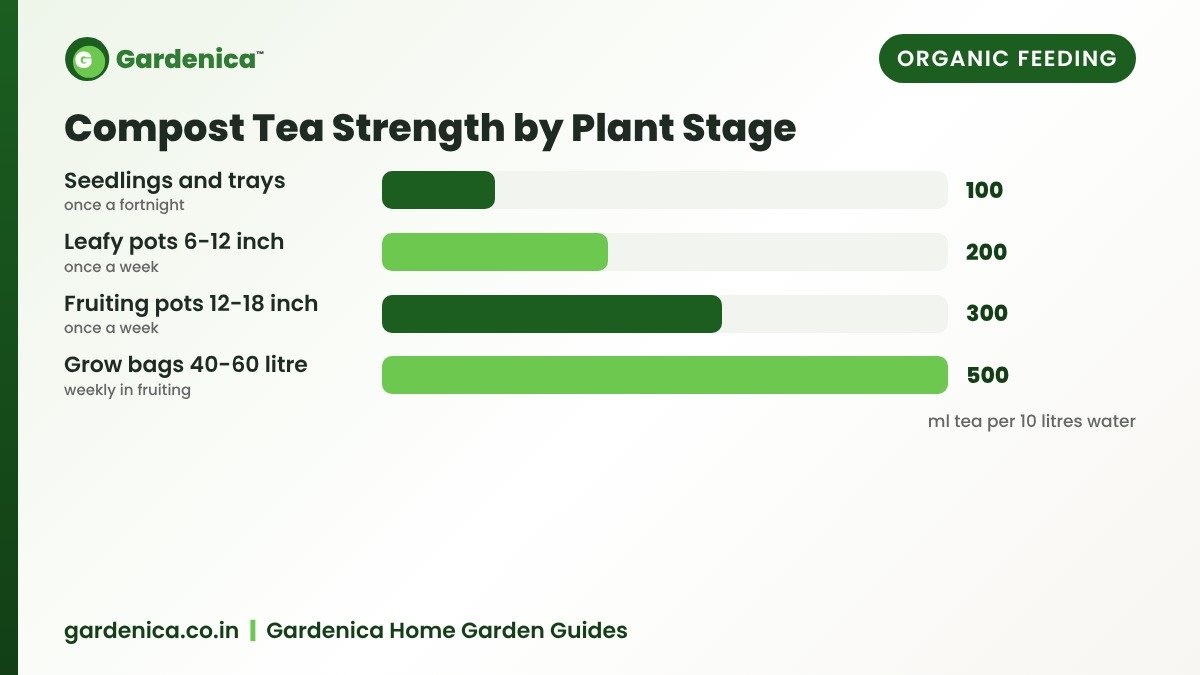
Straight tea is too strong for a pot's confined root zone and can scorch seedlings. Dilution is the most important number here.
- Seedlings and trays (Tea (ml): 100; Water (litres): 10; Note: Very light colour, once a fortnight)
- Leafy pots 6-12 inch (Tea (ml): 200; Water (litres): 10; Note: Palak, methi, coriander, lettuce)
- Fruiting pots 12-18 inch (Tea (ml): 300; Water (litres): 10; Note: Tomato, brinjal, chilli, capsicum)
- Grow bags 40-60 litre (Tea (ml): 500; Water (litres): 10; Note: Once a week during fruiting)
Where It Fits in a Winter Plan
November and December across most of India mean cool air, weak sun and soil that stays wet for days. Roots work slowly in that weather, and a dry pellet on the surface may sit there for two weeks. A weekly tea keeps feeding going while the plant still needs nitrogen to hold its leaf colour. These notes on Winter plant care in pots cover the watering side.
Feed between 8 am and 10 am so the mix drains before night cold settles in. Never pour tea on frozen or bone-dry soil, and skip it for 7-10 days during a cold wave.
Compost Tea, Seaweed and Humic Acid
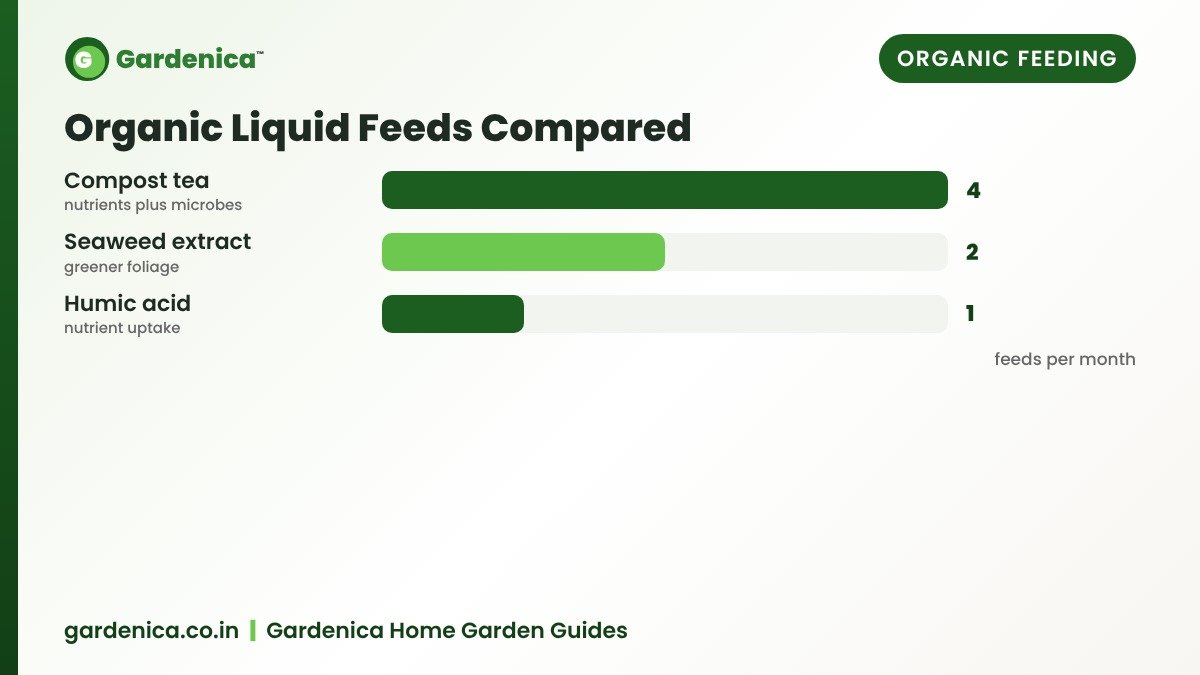
These organic inputs get confused with each other, but they do different jobs, and one pot does not need all of them.
Have a question about this topic?
Chat on WhatsApp- Compost tea (Main job: Soluble nutrients plus soil microbes; Feeds per month: 4)
- Seaweed extract (Main job: Growth support and greener foliage; Feeds per month: 2)
- Humic acid (Main job: Helps roots take up what is in the mix; Feeds per month: 1)
Signs the Brew Has Gone Wrong
Smell the bucket before you strain it. Your nose is faster than any test.
- Rotten or sour smell. The brew went anaerobic, usually from sun or no stirring. Discard it into a bed, not a pot.
- White film that smells foul. Mould from a brew left too long. Steep 3 days, not 10.
- Green water. Algae from an open bucket in bright light. Keep the lid on.
- Leaf tips burning after feeding. The tea went on too strong. Double the dilution next time.
- Tiny flies over the bucket. A covered lid and a shorter steep fix this.
A good tea smells like a forest floor or a clean water tank. Anything sharper is a warning.
Safe Use at Home
- Wear gloves while handling the compost and the steeping bag, and wash your hands afterwards.
- Keep buckets covered and away from children and pets, since an open bucket of standing water is a drowning and mosquito risk.
- Do not taste the tea, and never use it on salad leaves within two days of harvest.
- Follow the label on any product you add, and add nothing above the stated dose.
- Do not store strained tea past a day, and never keep it sealed in a bottle.
Frequently Asked Questions
How long should compost tea steep for potted plants?
Three to five days in the shade, with a hard stir every morning. Under three days little comes off the compost; past a week the brew turns sour.
Do I have to dilute compost tea before using it on pots?
Yes. Pots hold a small volume of mix and roots sit close together, so straight tea can burn leaf tips. Dilute 100-300 ml into 10 litres of water depending on the stage.
Can I use compost tea on flowering plants too?
Yes. Roses, marigolds and gerbera take it at the same 300 ml per 10 litres strength used for fruiting pots. Keep it off open flowers and pour at the base.
How often should I apply compost tea in winter?
Once a week is plenty for most pots. In a cold wave, when soil stays wet and growth stalls, skip feeding for 7-10 days and resume on a warm morning.
Can I make compost tea from kitchen scraps instead of vermi compost?
Not safely for pots. Unfinished kitchen waste carries pathogens and turns anaerobic quickly in a bucket. Mature vermi compost is the reliable choice.
What do I do with the compost left in the bag after brewing?
Spread it around the base of a plant or work it into a bed. Most of the coarse organic matter survives steeping, so it works as a mulch.
Will compost tea replace my regular fertiliser?
It covers most weekly feeding for leafy pots, but a crop like tomatoes still needs the base dose mixed into the pot at planting. Treat tea as the top-up.
Conclusion
Compost tea is the cheapest way to keep a pot garden fed through a slow winter, because it delivers nutrients and microbes to the root zone with the watering you were going to do anyway. Brew it from mature vermi compost, dilute it to the strengths above, and water it in on a weekly morning routine. Start with one 15-litre bucket this weekend and keep the schedule four weeks before judging results.
For the inputs, Gardenica Vermi Compost and Neem Cake Powder cover the brew, and the Gardenica team is on WhatsApp at +91 95120 17162 for a feeding plan.
Disclaimer: This article is general gardening information. Results vary with plant, pot, soil, weather and care. Always read and follow the product label.
Looking for more?
Continue to our main page to explore products and services.