Potassium Deficiency in Pots: Why Winter Tomato Edges Burn and Curl
Potassium Deficiency in Pots: Why Winter Tomato Edges Burn and Curl
You water on time, you feed every fortnight, and still the older tomato leaves on the sunny side of the terrace start browning at the rim. The plant looks almost healthy from a distance, yet the fruit stays small and the lower leaves crisp up one by one. In winter pots this pattern is usually potassium deficiency, and it is far more common in containers than in ground beds.
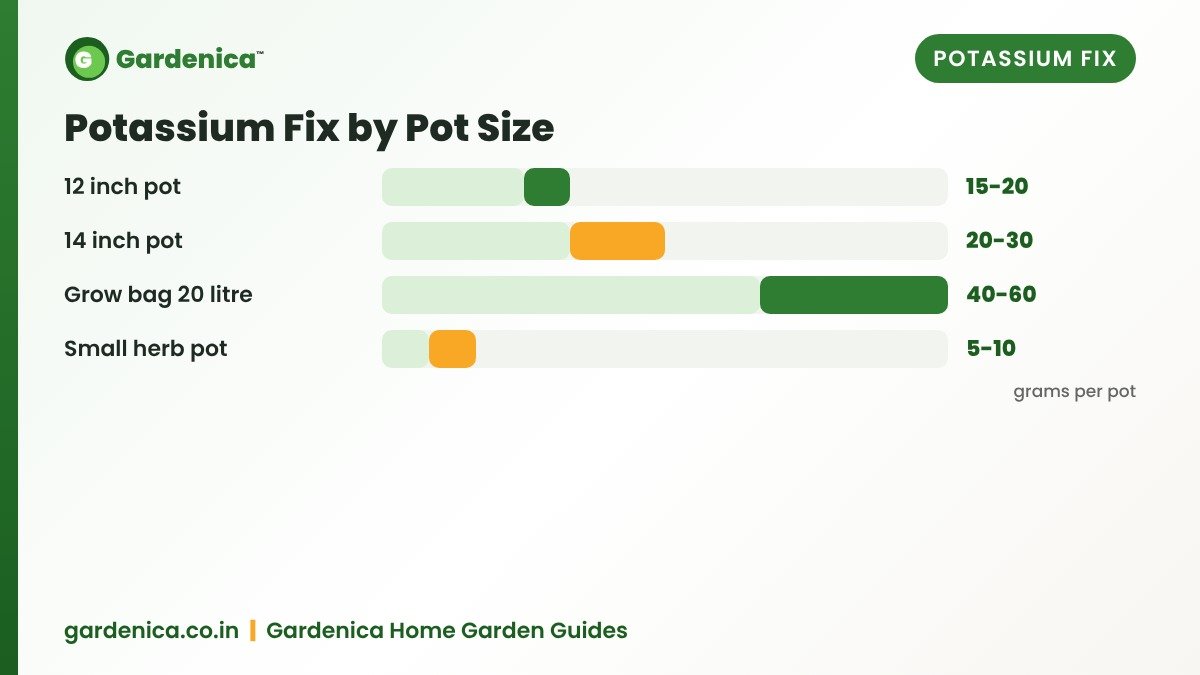
This guide covers how to tell potassium shortage apart from sun scorch, salt burn and nitrogen hunger, which organic inputs actually put potassium back into a pot, and how much to use for a 12 inch pot versus a 20 litre grow bag. It also covers the winter watering habits that lock potassium out of the root zone, because that is where most balcony gardens go wrong.
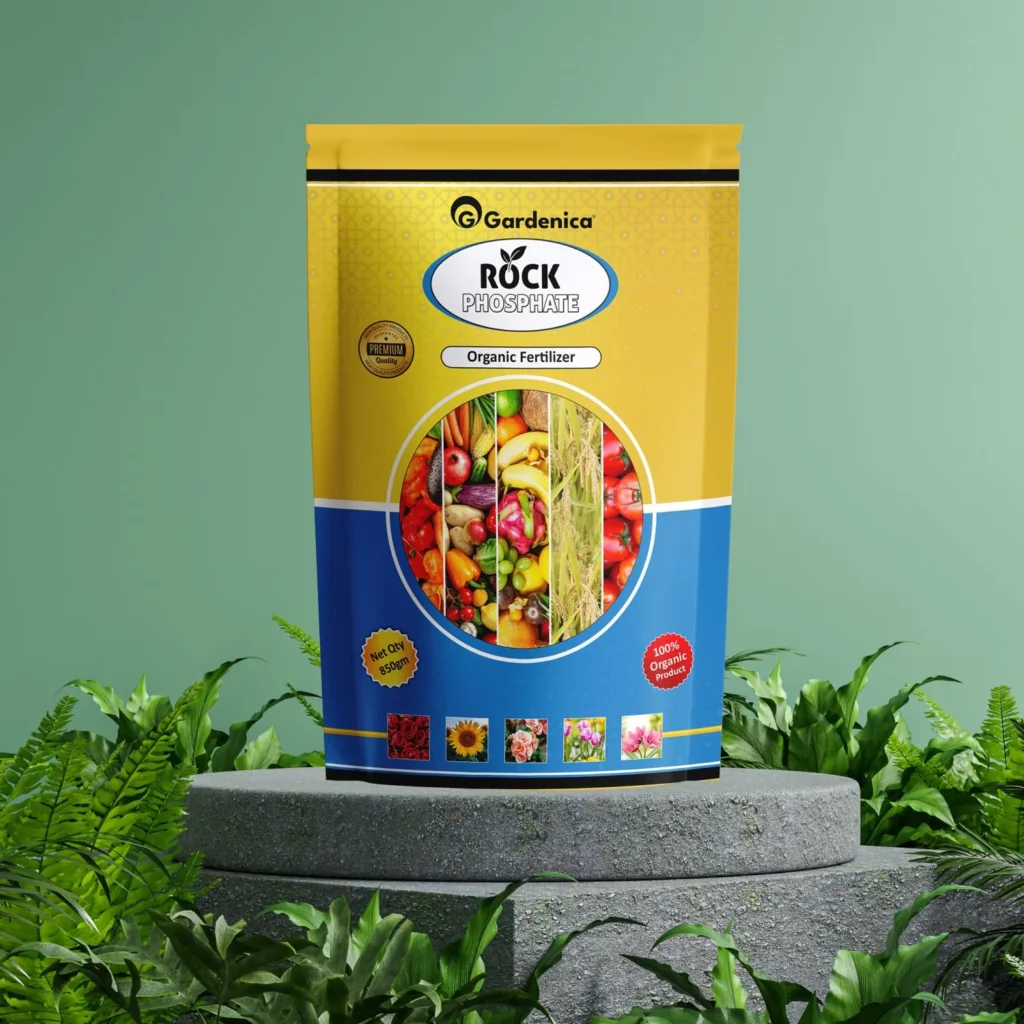
Read more: Explore Gardenica Rock Phosphate
What Potassium Does in a Potted Plant
Potassium moves freely inside the plant, so the plant pulls it out of the older leaves whenever the young growth or a developing fruit needs it. That is exactly why the damage shows at the edges of the oldest leaves first and the growing tip stays green. Potassium runs the opening and closing of leaf pores, water movement through the plant, sugar transport into fruit, and the plant's own tolerance of cold nights and hot afternoons.
How to Recognise Potassium Deficiency in Pots
The signs come in a predictable order, oldest leaf first, edge first. Reading them in order saves you from treating the wrong problem.
- Yellowing starts at the margin. A pale band appears along the very edge of the oldest, lowest leaves while the middle of the leaf stays green.
- The edge turns paper brown. That pale band dries into a crisp brown scorch that feels brittle between the fingers and does not spread inward.
- The leaf cups upward. Older leaves curl or cup downward at the tip, sometimes called a claw, and the plant looks tired by late afternoon.
Potassium Deficiency or Something Else
Half the pots brought to our counter in Ahmedabad for a potassium fix turn out to be a different problem with a similar look. Compare before you dose.
- Potassium deficiency (Where it shows first: Oldest leaves, outer edge; Key difference: Crisp edge scorch, inner veins green)
- Nitrogen deficiency (Where it shows first: Oldest leaves, whole leaf; Key difference: Even pale yellow all over, no browning)
- Iron chlorosis (Where it shows first: Newest leaves; Key difference: Yellow between green veins, tip first)
- Sun scorch (Where it shows first: Leaves facing the sun; Key difference: Pale patches on the leaf face, edges intact)
Why Winter Pots Run Short
Cold slows roots more than most gardeners expect. Soil under 15-16 degrees Celsius takes up potassium very slowly, so a healthy December root in a north Indian balcony cannot drink in the potassium that is sitting right there in the media. Waterlogged media makes it worse, because roots without oxygen cannot push nutrients inward.
Organic Sources That Actually Work
Real wood ash, banana peel, rock phosphate and composted plant matter are the practical options. Use one or two, not all four.
- Wood ash (Dry matter (g per pot): 15-30; Best for: Quick edge scorch fix)
- Banana peel powder (Dry matter (g per pot): 20-40; Best for: Fruit crops, slower rise)
- Rock phosphate (Dry matter (g per pot): 30-50; Best for: Long season flowering pots)
- Potassium-rich liquid feed (Dry matter (g per pot): 50-100 ml diluted; Best for: Weekly maintenance)
The Fix, Step by Step
Work through this in one morning while the pots are still dry.
- Check the pattern first. Look at the oldest leaf, not the top. Edge scorch with green inner veins confirms a potassium issue rather than a watering or pest problem.
- Test the media drainage. Push a finger 5 cm deep. Soggy or sour-smelling media means roots cannot feed, so fix drainage before dosing anything.
- Water the pot plain first. Damp media takes up a feed far better than bone dry media, which sends the solution straight out of the drainage holes.
- Apply one potassium source. Sprinkle the measured ash or peel powder over the top 3-5 cm, scratch it in with a hand trowel, and water it in gently.
Feeding Plan for the Rest of Winter
In December and January, feed once every 15 days rather than weekly, because cold roots cannot use more than that. Warm the water for a few hours in the sun before applying it on cold mornings. Once the light strengthens in February, move to a 10-day cycle for fruiting crops.
Have a question about this topic?
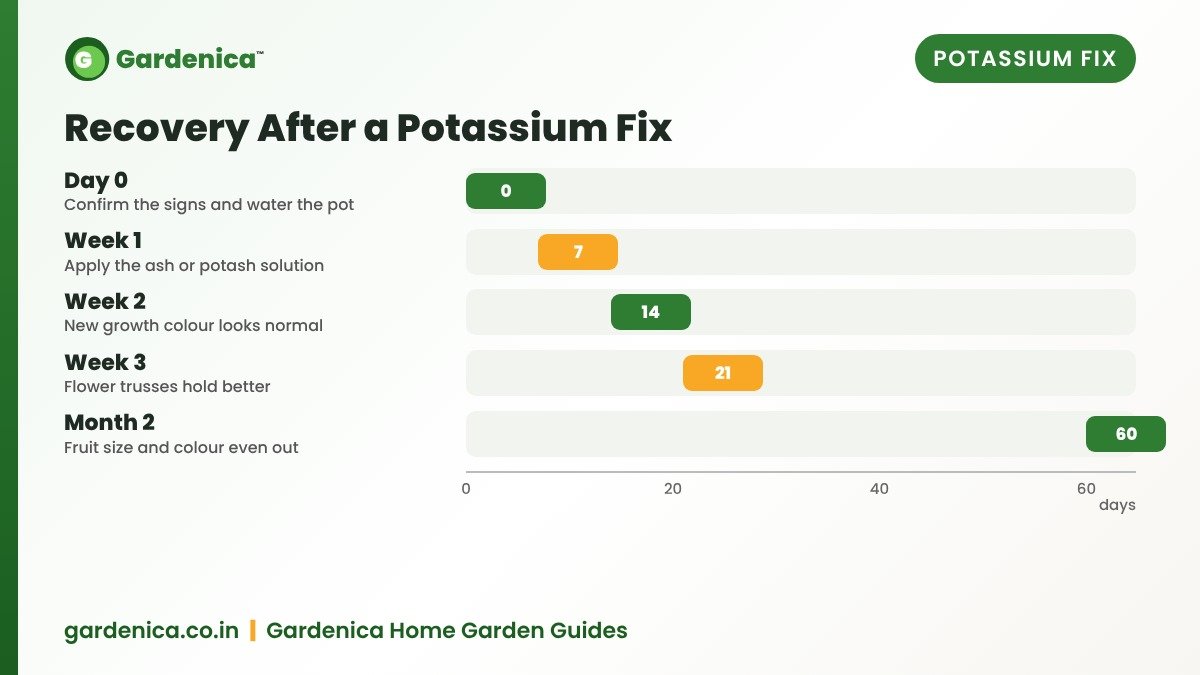
Chat on WhatsApp- Symptom check (Days: 0; What to do: Read the oldest leaf, test drainage)
- First dose (Days: 7; What to do: Apply ash or peel powder, water in)
- Second dose (Days: 21; What to do: Repeat at half the first dose)
- Steady feeding (Days: 30-60; What to do: Every 15 days through winter)
- Peak season (Days: 60-90; What to do: Every 10 days as fruit sets)
Safe Use at Home
- Wear gloves with wood ash. Ash is caustic when wet and stings cuts. Wear simple garden gloves and keep it away from your eyes.
- Keep children and pets back from the top dressing. Keep the pot edge out of reach until the ash or powder is watered in and dry.
- Read the product label. Follow the dose, dilution and interval printed on the pack, and never mix two concentrated feeds in one watering can.
- Store dry and sealed. Keep ash in a closed metal or plastic container, labelled, away from any food jar.
Frequently Asked Questions
How do I know if my tomato plant has potassium deficiency?
Look at the oldest, lowest leaves. A pale band along the outer edge that dries into a crisp brown scorch, with the inner veins still green, is the classic sign. New leaves at the top stay normal, and fruit stays small and slow to ripen.
Is wood ash safe for all potted plants?
Use it sparingly and only from untreated firewood. A teaspoon to a tablespoon per pot, scratched into the top layer and watered in, is enough. Skip it or halve the dose for acid loving plants such as gardenia and strawberry, since ash raises pH.
How fast does a potassium fix show in a pot?
Leaf edge scorch will not heal, since damaged tissue does not recover. Look for firmer new growth and better truss hold in 10-14 days, and for even fruit size and colour over the next 4-6 weeks.
Can I give banana peel water every day?
No. Soak chopped dried peel overnight, strain it and dilute it with an equal part of plain water, then apply once every 10-15 days. Daily use makes the media sour and draws fungus gnats.
Why do my pots run short of potassium when I feed regularly?
Potassium leaches out of every watering, and a pot holds only 10-15 litres of media. Cold winter roots under 15-16 degrees Celsius also take it up very slowly, so a heavy feed in December does less than the same feed in February.
Does rock phosphate give potassium?
It is mainly a phosphorus source, but it carries calcium and small amounts of potassium and supports flowering and fruiting over a full season. Pair it with a faster source such as wood ash when the edges are already burning.
Should I remove the burnt leaves?
Trim only leaves that are more than half brown, and use clean snips. Leaves that are partly green still feed the plant, and stripping too many at once stresses a fruiting tomato or chilli.
Conclusion
Potassium deficiency in pots shows up where you can least ignore it: crisp brown leaf edges, cupped old leaves, flowers that drop and fruit that never fills out. Confirm the pattern on the oldest leaf, get the drainage right, then add one organic potassium source at the measured dose and let the plant take a fortnight to answer. If you want a feeding plan built around your pot size and crop, Contact the Gardenica team and we will work it out with you on WhatsApp at +91 95120 17162.
Disclaimer: This article is general gardening information. Results vary with plant, pot, soil, weather and care. Always read and follow the product label.
Looking for more?
Continue to our main page to explore products and services.